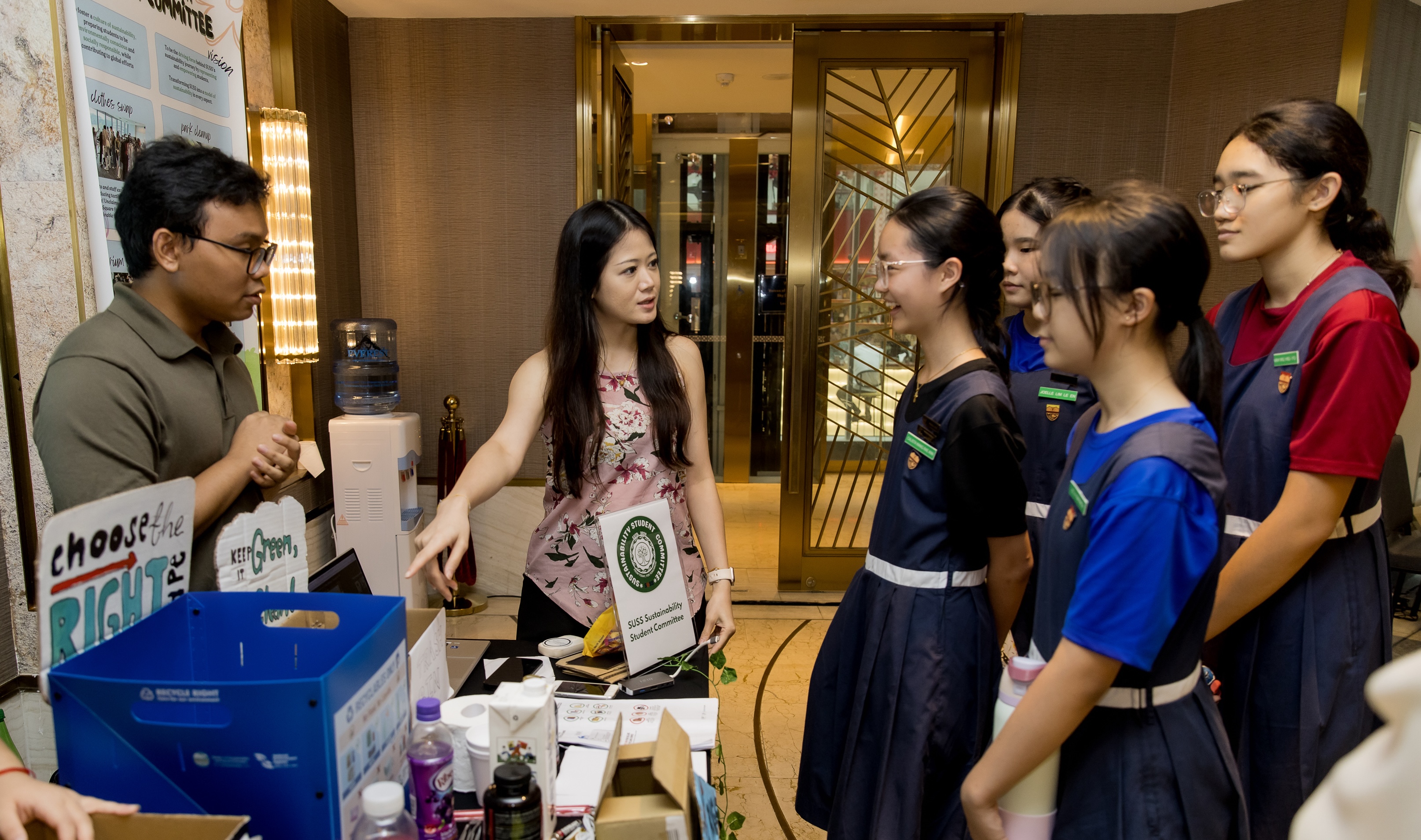

Turn your sustainability idea into real-world impact in your school or community.
The OCBC TSYF Changemaker Challenge empowers young people to turn sustainability ideas into real-world impact.
Participants identify a sustainability challenge in their school or community, develop an innovative solution using Design Thinking principles, and compete for funding to bring their ideas to life.
Winning teams receive project grants, mentorship opportunities, and the chance to showcase their work at The Sustainability Youth Festival.

Bring your ideas to life with project grants for winning teams.

Use empathy, research and creativity to develop impactful solutions.

Present your project at TSYF and inspire others to take action.
Junior Colleges / Centralised Institutes, Institutes of Technical Education (ITE), Polytechnics, Universities, Youths up to 35 years old.
All Secondary Schools in Singapore
Junior Colleges / Centralised Institutes, Institutes of Technical Education (ITE), Polytechnics, Universities, Youths up to 35 years old.
To enter the challenge teams need to submit both of the following:
Provide an overview of your project, including the sustainability challenge it addresses, the stakeholders it aims to benefit, and how it supports one or more pillars of the Singapore Green Plan 2030.

Problem Statement: Clearly describe the sustainability challenge your project aims to address and explain why it is important.
Target Audience: Identify the stakeholders or community groups your project is designed to benefit.
SG Green Plan Alignment: Explain how your project supports one or more pillars of the Singapore Green Plan 2030.
Empathise: Research stakeholders’ needs, current sustainability challenges, and any existing solutions.
Define: Develop a clear problem statement based on your research findings and explain why the issue remains relevant and insufficiently addressed.
Ideate & Create Solutions: Generate and develop innovative solutions that address the identified challenge.
Goals & Objectives: Define what your project aims to achieve and how success will be measured.
Methodology & Work Plan: Describe the activities, campaigns, or initiatives involved, including the sustainable practices promoted or sustainability issues addressed.
Budget & Resources Required: Outline the resources, materials, funding, and partnerships needed to implement your project.
Expected Outcomes & Long-Term Impact: Describe the expected benefits and sustainable impact on your school or community.
Evaluation & Success Metrics: Explain how your team will measure, test, and evaluate the effectiveness of the project and its contribution to the SG Green Plan.
Create a video (max. 10 minutes) that introduces your team, the sustainability challenge you are addressing, and your proposed solution.


Team Introduction: Introduce your team members and their roles.
Sustainability Challenge: Explain the issue your project aims to address and why it matters.
Motivation: Share what inspired your team to tackle this challenge.
Proposed Solution: Present your idea and explain how it works.
Expected Impact: Describe the positive change your project aims to create.
Supporting Visuals: Include relevant visual content such as campaign footage, artwork, community activities, interviews, prototypes, or demonstrations to enhance your presentation.
Examples of projects that engage schools or local communities to encourage sustainable behaviours.
Examples:
- Waste reduction campaigns
- Sustainable fashion workshops
- Community engagement programmes
Innovative products, services, technologies or prototypes that address sustainability challenges.
Examples:
- Recycling innovations
- Energy-saving solutions
- Circular economy concepts
Projects focused on increasing knowledge, changing behaviours and promoting sustainable practices.
Examples:
- Educational campaigns
- Learning modules
- Awareness initiatives
Projects are evaluated using a scoring rubric that measures impact, research, innovation and feasibility.
Select your division to view the judging criteria.






Here's an overview of key dates for the OCBC TSYF Challenge. Mark your calendar and start planning your journey!
Win a booth showcase space at TSYF 2026 with a chance for more prizes for the most interesting activities!